AI Agent Development Services
Our AI Agent Development Services
Custom AI Agent Development
Developing AI agents for specific business tasks (taking a request, retrieving information, carrying out actions via tools and APIs etc).
AI Agent Consulting
Review your workflows, your data and your software to identify where AI agents make sense and what is needed to implement them.
AI Agent Integration
Connecting agents up to CRMs, databases, internal apps and third party APIs so they can access the information and interact with the existing systems.
Multi-Agent System Development
Building systems where several specialized agents take on different aspects of a workflow, pass information to each other and co-ordinate their activities.
RAG-Powered AI Agents
Connecting agents to internal documents, knowledge bases and business data via retrieval augmented generation (RAG).
AI Agent Workflow Automation
Develop agents that can process information, select actions and move work between systems, with appropriate approval steps for any operations that require a human to approve.
AI Agent Testing & Security
Testing agent behavior, managing access permissions, dealing with failed actions and setting limits on what an agent is allowed to do.
AI Agent Maintenance & Optimization
Updating the models and integrations, improving our task completion rates, monitoring API usage and fixing any issues that we find post-deployment.
Our Projects
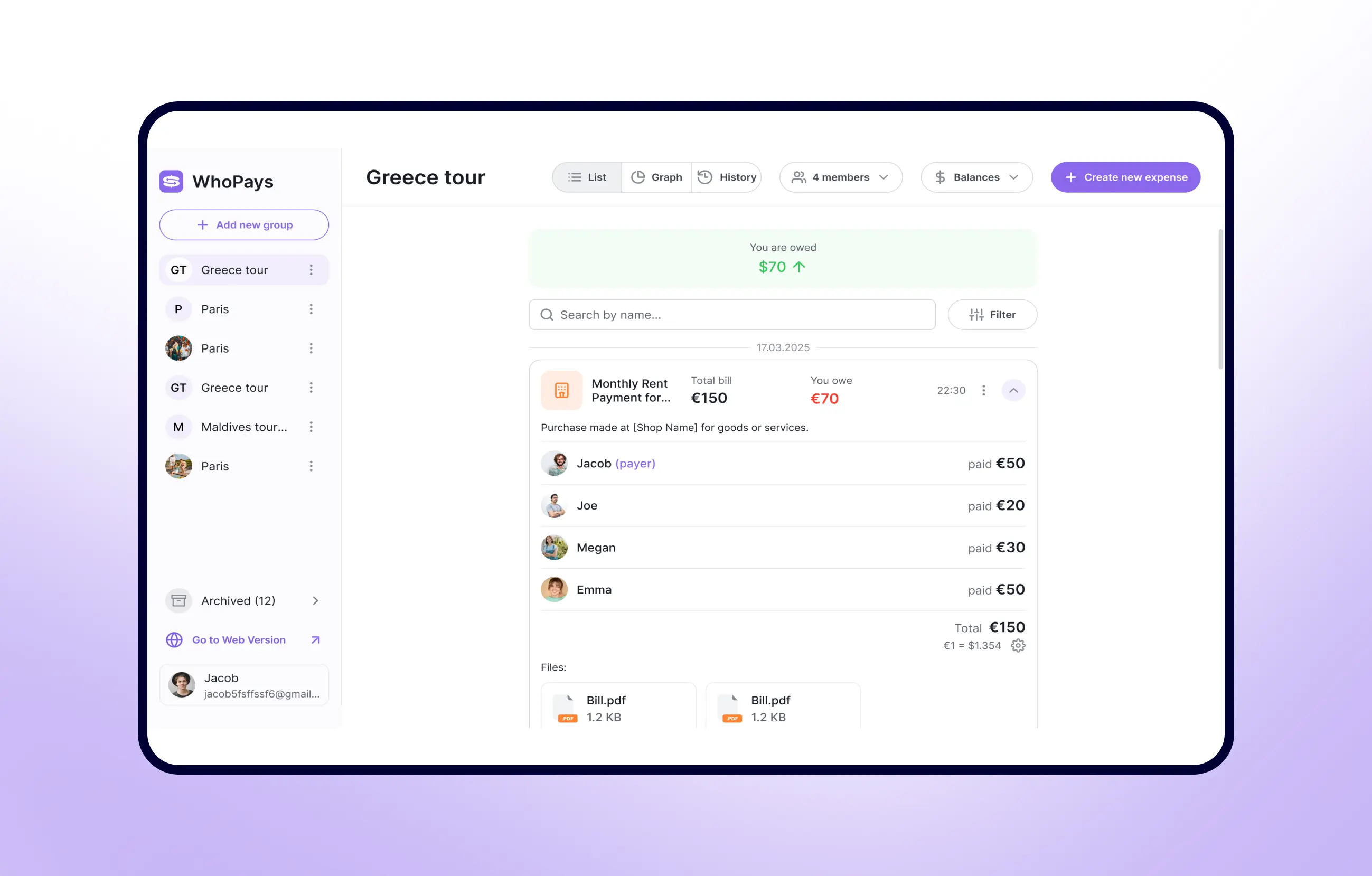
Personal Finance App Development
A personal finance app that helps groups split expenses, track balances, and settle payments without manual calculations.
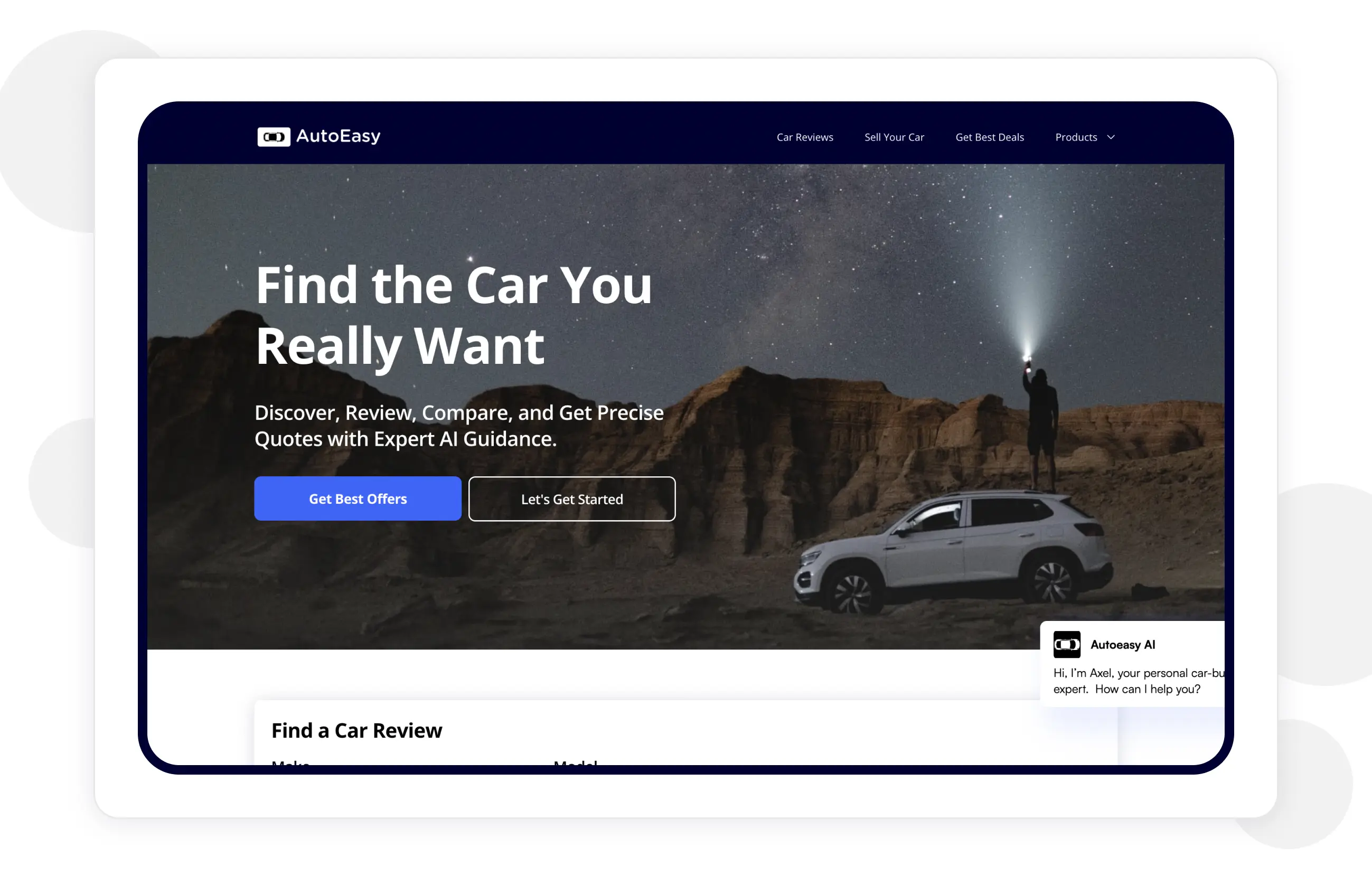
AI-Powered Car Shopping Website Development
An AI-powered platform that helps users find the best car deals through automatically generated reviews, comparisons, and rankings.
Types of AI Agents We Develop
Customer Support Agents
Agents who check the customer's details, pull order/account information, draft the response and create/update the support ticket.
Sales & Lead Qualification Agents
AI agents that gather the lead information, validate it against the defined criteria, update the CRM records and create the requisite follow-up tasks for the sales teams.
Financial Operations Agents
Agents to review the financial documents, collect the transaction data, check the records and prepare the information for the internal financial processes.
Document Processing Agents
Agents that pull information from invoices, contracts, forms and the like, check that the required fields are present and then pass the data in a structured format to the relevant systems.
Internal Knowledge Agents
AI agents connected to company documentation and databases. Employees can ask questions, pull information and complete certain tasks via the agent without having to jump around between a number of different tools.
SaaS Product Agents
Agents built into existing SaaS products to assist users with information management, report generation, record updates and so on.
AI Agent Development for Different Industries
AI Agents for FinTech
AI agents can be used to assist with financial document reviews, transaction categorisation, customer support and KYC/KYB workflows. We integrate them into existing financial systems with the appropriate access controls in place to protect sensitive operations.
AI Agents for SaaS
We build AI agents that work with SaaS product data, produce reports, update records and carry out multi-step tasks via the various APIs and backend services.
AI Agents for Business Operations
AI agents can gather information from a range of tools, process documents, update records and pass data from one system to another. Any task which involves sensitive information or a significant business decision will require employee approval.
Our AI Agent Development Process
1. Reviewing the Workflow
We start with the task that the agent is to perform. That involves reviewing the current process, the data that's available, the integrations that are required and the decisions that should stay with the human.
2. Planning & Proof of Concept
Next we define the agent's responsibilities, pick the technical approach and determine what tools it has access to. For more complex tasks a proof of concept can be used to test the idea prior to full development.
3. Development & Integration
Our engineers implement the agent logic, connect the required APIs and data sources, and develop the supporting backend functionality. We also configure permissions, error handling and approval steps as required.
4. Testing & Deployment
We test the agent with scenarios that are based on the intended workflow (incomplete information, failed tool calls, unexpected responses etc). Post deployment we can then go and have a look at its performance, API usage and the errors that recur.
Want to Know the Cost of Your AI Agent?
Name
Why Choose Stubbs for AI Agent Development?

Experience with Complex Software Integrations
Our engineers have worked with payment providers, banking APIs, digital asset services and identity verification platforms. That experience is useful when an AI agent needs to communicate with several systems and dealing with structured data.
Full-Stack Development Expertise
Building an AI agent typically involves some backend development (databases, APIs etc) and of course a UI. We work with React, Next.js, Node.js and TypeScript so the agent and the application that it sits in can be built by the same team.
FinTech & SaaS Background
Our portfolio includes financial platforms, cryptocurrency exchanges, marketplaces, and SaaS applications. We understand the role of permissions, transaction logic and external integrations in that kind of product.
100+ Projects Delivered
Since 2019 Stubbs have delivered over 100 software projects. The team comprises 20+ mid and senior level specialists across web, mobile, backend and AI development.
Flexible Cooperation
We can build the AI agent as a standalone project or provide engineers to work with your existing team. Our collaboration models are project based, staff augmentation or dedicated teams.
Frequently Asked Questions
1. What are AI agent development services?
What are AI agent development services?
AI agent development services involve creating software agents that can work with data, use external tools and carry out tasks as part of a workflow. A bot is different in that it may be required to fetch a record, call an API, check a piece of information, or update another application. The development process encompasses the agent's logic, the model itself, access to the business data, the testing and the back end to actually run the agent.
2. How much does AI agent development cost?
How much does AI agent development cost?
The cost will be a function of the agent's responsibilities, the number of integrations and the level of control required over the connected systems. At Stubbs a fairly focused AI PoC would be in the 3k-10k range. A production agent with a number of tools, a number of permissions and approval workflows would be a separate exercise in estimation. You'd also have to account for the cost of model API usage, hosting and ongoing maintenance.
3. How long does it take to develop an AI agent?
How long does it take to develop an AI agent?
A basic proof of concept might take a few weeks, an AI agent connected to a number of business systems could take several months. The integrations, the data that's available and the testing will more than likely have a bigger impact on the time frame than the model connection itself. Agents that are going to be doing record updates or some of the more sensitive actions will of course require additional access controls and validation. We'll give an estimate after we've had a look at the intended workflow and the existing infrastructure.
4. What is the difference between an AI agent and an AI chatbot?
What is the difference between an AI agent and an AI chatbot?
An AI chatbot is primarily a conversation handler, answering questions and providing information to users. An AI agent can also use tools and take action to achieve a result. So a chatbot might be used to explain how to update a customer's account, whereas an agent would be able to go and retrieve the record and make the change. Not every conversational application requires an agent, of course, particularly if all the app is doing is providing answers from a knowledge base.
5. What is the difference between AI agents and AI automation?
What is the difference between AI agents and AI automation?
Traditional automation follows predefined rules and a set of sequences. An AI agent can use a language model to read the information, pick from the available tools and decide which of the allowed steps it should take next. That can be a very useful approach when the inputs are variable or when you're working with unstructured data. The two can also be used in conjunction with each other: the agent could be responsible for the document interpretation and the traditional automation would then take over to do the actual calculations, the validation and the database update.
6. What are multi-agent systems?
What are multi-agent systems?
A multi agent system is one where you have a number of agents each with a different responsibility to carry out the overall task. One agent might be responsible for pulling the data, another for processing the documents and a third for producing the final output for review. That said a multi agent system isn't always the right answer. You can often achieve the same outcome with a single agent which has access to the appropriate tools. We only go down the multi agent route when the workflow genuinely benefits from that separation.
7. Can AI agents work with our existing software?
Can AI agents work with our existing software?
Yes. AI agents can be connected to existing applications via APIs and other supported integration methods. This could be to existing CRMs, SaaS platforms, databases, document management systems and a whole range of internal business systems. We'll first go through what operations are available and what information the agent will need. In some cases it will be necessary to build additional backend endpoints or an integration layer before the agent can carry out the required work.
8. Can an AI agent access our internal documents and databases?
Can an AI agent access our internal documents and databases?
Yes, as long as the appropriate access is available and properly controlled. For company docs and knowledge bases we'd use retrieval augmented generation (RAG) to feed the agent the relevant information. Structured data can be pulled via API or database query. Access control is absolutely critical in this scenario: the agent must only be able to retrieve records that the current user or workflow is permitted to access.
9. Do we need to train a custom AI model to build an agent?
Do we need to train a custom AI model to build an agent?
Not in any way necessarily. A lot of AI agents will simply be using an existing language model via an API. The bulk of the work involved in building an agent is in defining the workflow, connecting the tools, managing the data access and then dealing with the results that the model returns. Custom training may be worth looking at in some cases where the off the shelf models aren't good enough for the task at hand, but that's not the norm.
10. How do you ensure AI agents perform tasks correctly?
How do you ensure AI agents perform tasks correctly?
We test the agents against a set of representative tasks and expected outcomes (including cases where the information is missing or an external service fails). It's not enough to just check the final answer, you need to check the actions that were taken en route. We can have validation rules, tool restrictions, execution logs and human approval steps. All of these serve to reduce the risk of bad actions, though you can never quite eliminate the possibility of an error.
11. How do you handle security in AI agent development?
How do you handle security in AI agent development?
Security starts with limiting the information and tools available to the agent. We have authentication, permissions, secure API communication and controls over what the agent can do. Sensitive operations (e.g. changing a financial record) will have additional validation or approval requirements. For a FinTech product the relevant obligations would be GDPR, KYC/AML, PCI DSS and various controls associated with ISO 27001 and SOC 2 (depending on the product).
12. Can AI agents perform actions automatically?
Can AI agents perform actions automatically?
Yes, but the level of autonomy should be commensurate with the risk of the task. An agent could be set up to automatically categorise incoming requests, pull documents, produce reports etc. Actions which involve payments, customer accounts and the like would of course require a much higher level of control. You could set an agent up to produce an action and then request approval before it carried it out rather than just giving it free access to the connected systems.
13. What technologies are used to develop AI agents?
What technologies are used to develop AI agents?
AI agents generally consist of language models, tool calling capability, backend services and data retrieval. Frameworks such as LangChain and LangGraph can be used to structure the agent workflows and RAG is useful when you're working with internal docs and knowledge bases. At Stubbs our core app stack is Node.js, TypeScript, React, Next.js and a mix of databases (PostgreSQL and MongoDB). The agent architecture and the tooling that goes with it is selected on a per-workflow basis.
14. Can we start with an AI agent proof of concept?
Can we start with an AI agent proof of concept?
Yes, a proof of concept is useful if you want to establish whether an agent can actually do a job before you go ahead and build a full blown application. You can test the proposed model, connect a limited set of tools and see what happens with a set of sample tasks. It's a good way of identifying any problems with data access or integration complexity. You can then work out what further work is required to get to production.
15. Do you provide AI agent developers for hire?
Do you provide AI agent developers for hire?
Yes. Stubbs offer developers via staff augmentation and dedicated team models. Our engineers can be brought in to work on model integrations, agent workflows, API connections, RAG etc and the application around it. You can augment your existing team or you can work with a dedicated team for a larger project. The make up of the team and the hourly rates will be dependent on the level of technical expertise required and the scope of responsibility.
16. Do you provide maintenance after deploying an AI agent?
Do you provide maintenance after deploying an AI agent?
Yes. AI agents will require maintenance as the model APIs, the business processes and the applications they're connected to change. Maintenance can be as simple as fixing an integration, tweaking a prompt or a workflow, looking at the failures that occur and improving the quality of the responses. It can also be useful to monitor model usage and the number of tool calls as these have a direct impact on operating cost. We can provide ongoing support or work on specific improvements post deployment.
We would love to help.
What are you interested in:
Name
Tell us about your project and goals
0/1000
Add your file
